
Zeroing out
Notes on Boorman's Point Blank
Tomorrow, Wednesday March 11, at 7pm, for Interintellect, I will be hosting the Part II of a three-part reading group on Heinrich von Kleist’s Michael Kohlhaas, Kafka’s “Before the Law,” and J. M. Coetzee’s Waiting for the Barbarians. (Obtain your ticket to tomorrow’s salon here; or purchase the entire series here.) In honor of the hero of tomorrow’s discussion, I am resharing this older meditation on another obsessive ledger-balancer: Lee Marvin’s Walker (adapting the Parker of the hard-boiled novels by Richard Stark). Happy reading, and hopefully I will see some of you this evening.
—PF
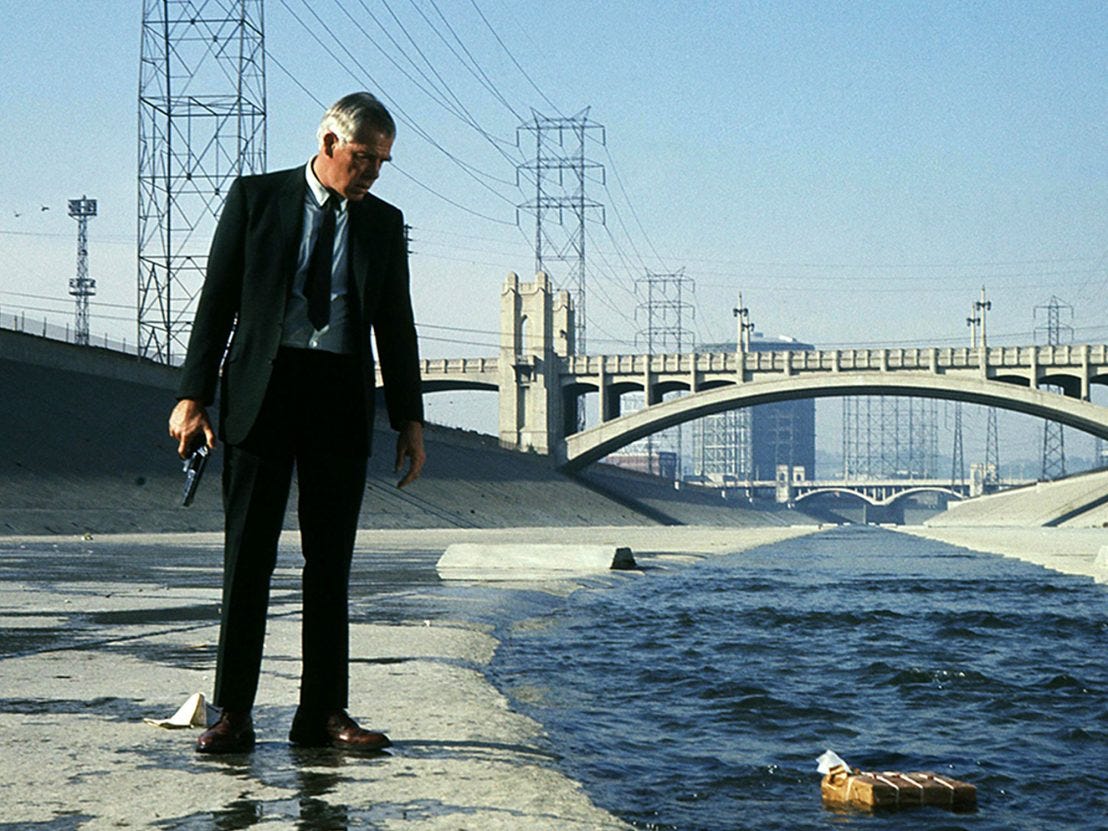
A fool says that Point Blank lacks character development. A second fool, the kind moved to disputation, hence to stating the obvious, replies that this misses the point: not just of the film’s stylishness, its color-coordinated greens and yellows, but a more basic fact of genre. Is not the film a kind of silent comedy, with Lee Marvin as its clown? It is our Mr. Hulot’s Holiday. Well then.
(The clownishness of Marvin in Point Blank, like all clownishness, is afflicted with melancholy. As so often, this stems from a kind of disproportion between the hero and his landscape: in this case, not his diminutiveness, but his pointless size and strength. Marvin’s Walker—the film’s apt rechristening of the “Parker” of Richard Stark’s novel—is a blank, a slab of vertical meat, bound on redress. And yet, likewise typical of silent film clowns, he is characterized as well by an improbable grace. For this you need only watch the moment when Marvin, striding through a parking garage below the apartment building whose penthouse is occupied by his rival, to which he plans shortly to lay siege, suddenly, after being shot at, reverses himself to step behind a concrete pillaster without breaking stride. A movement of the purest, clownlike elegance: strong strides forward, gunshot, identical stride backward. Needless to say, this reversal is not a retreat.)
THIRD FOOL [the wisest, despite being unable to let things rest]: All that is true—yes, backing behind the concrete pillar in the parking garage—but I now think it truer to say the film is a critique of character development. For there is in fact a character in it who “develops,” who has needs and wants and desires; and he is the villain. He develops in the most literal sense, in that he starts poor and ends up rich, and apparently respectable. He moves up in the world: from the gutter to the penthouse. Mal Reese, for that is his name, is not altogether a villain. He is partly sympathetic—and this is why we must hate him. He has needs and wants and desires, and these make him weak, and because he is weak, he is dangerous. To him compare Marvin’s Walker, whose desires, if they are such, are for nullity. They consist in the wish for restitution of the money that is his, that the balance-sheet be zeroed-out. Dangerous, he is not fundamentally so in the way of the other man, because his wishes are bounded. Once upon a time he did, of course, have development. He had a life, he had a wife, he had a friend; but they betrayed him, and he is over that now. (The scene where Walker puts the wedding ring on his dead wife’s finger is a wonder of enigmatic tactfulness: closing a chapter, without rancor, and with even a quiet marveling that it was. It is one of the moments of things being made whole, to the extent they can while being fundamentally broken.)
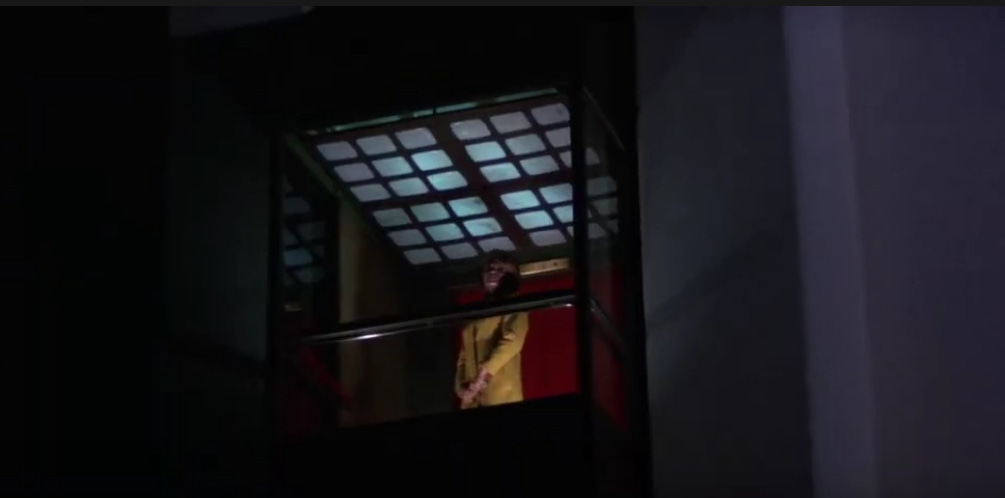
The relation between the Lee Marvin and the Angie Dickinson characters proceeds from a similar understanding. They act toward each other with what I want to call great tact, where the primary object of their tactfulness is themselves: on the lookout against getting involved, though allowing it to happen, to a certain limited extent. Walker wants to be made whole. He wants to be brought back to the beginning, broken though it was: a beginning that was an end, the end of the life of development. And he is brought back. The film begins and ends in a prison (Alcatraz), but he has balanced the ledger. And she, his dead wife’s sister—she wishes the same. When she gets in the elevator up to the penthouse to fuck Reese—a scheme to distract him so that Walker can make his way up on the sly and really fuck Reese—is this not women’s heroism? Stalwartness, resignation, strength in excess of all that will not tolerate in itself such weakness. When she looks across to Walker, they become secret-sharers, do they not? Whatever happens to the body, the soul is not affected—except insofar as a balance is restored. And when they are done they are done: zeroed out.
Oh I love this movie so much, glad to read you doing it justice. "The drop has changed, but the run is still the same."
Blind justice. Amcan and Idf flesh is grass mowing the lawn. Myself am planning to visit Erowid site to see if in inventing crystalline cocain some chemist was hoping just'is once to do herslef dome justice, g, bye cruel world.