
Paradise revised
Notes on Milton and Lawrence
John Milton is, after Spenser, the great Protestant poet of the English renaissance; D. H. Lawrence the great Protestant poet of English literary modernism. (T. S. Eliot, Anglo-Catholic, asserted his detestation of both.) And they have another literary commonality: each is the author of a literary work with Jesus as its central character. Milton makes Jesus the protagonist of Paradise Regained. For Lawrence, Jesus is the never named protagonist of the late novella originally and better titled The Escaped Cock, now more commonly known as The Man Who Died.
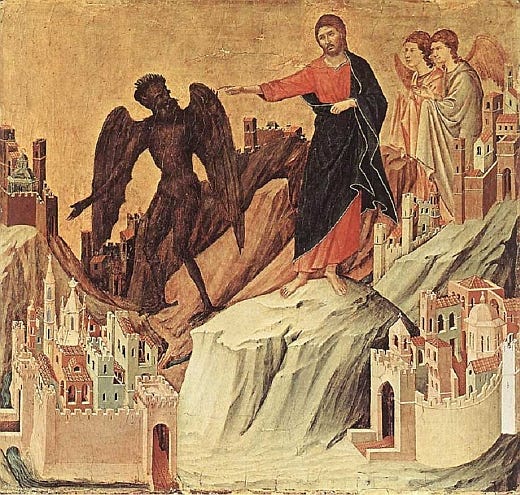
The Jesus each takes as his literary protagonist is emphatically Jesus the man, here on earth. Milton’s epic subject is Jesus’ temptation in the wilderness by Satan. In its emphasis on temptation and choice, it marks an authentic sequel to Paradise Lost, just as Jesus’s successful choosing marks him as the New Adam. Lawrence’s story is about a risen Jesus who set aside his own divinity—or, rather, transfigures it.
In a note to myself on my first reading of Lawrence’s novella, I wrote: Lawrence’s narrative bears out the logic, but not the modality, of the temptation. I am now less sure of this; am less certain, in fact, even what I meant by it, though I seek now to harvest its core, whatever its manifest falsity. Lawrence’s story requires of its “man who died” that he encounter experiences, in particular that of sexuality. (This marks a difference from Milton’s poem, in which Belial’s suggestion of tempting Jesus by sexuality is rejected by Satan as unworthy of him.) On another level, perhaps, there is a parallel in the temptations by which Milton’s Satan makes his assay: i.e., the temptations of political power and rational knowledge. Is it these Lawrence’s Man Who Died rejects, in rejecting his public mission, when he attains—through a second, metaphorical “death”—a new kind of intuitive seeing, almost a kind of blindness, in which he sees not entities, but the underlying “life” of which individual entities are a manifestation?
If Lawrence’s Jesus is the New Adam, then he tries to attain the status of Adam in Eden through a paradigmatic coupling. Death is the necessary prelude to the adequate resurrection through sex with the priestess of Isis. In Lawrence’s no doubt blasphemous terms, this is also to say that the Man undergoes the true crucifixion after his resurrection—what Lawrence everywhere calls crucifixion into and by sex.
As a reader, I find the full regeneration in the story’s second half inferior to the mere decoupling, the separatism of the attitude in the first half of the story, with its severe “libertarian” ethic of non-intervention in the affairs of others, albeit one that is congruent with a kind of “compassion.” (The premise of Lawrence’s novella: Jesus dies as Walt Whitman, and is reborn as—D. H. Lawrence. Jesus dies and comes back—as an asshole. Though the Priestess of Isis will promptly say: “I can fix him.”)
The religious ethos of the work is pantheistic: the necessity of the immersion of the “little life” of individuals in the “greater life.” One of its recurring motifs connects it to the thematic of blindness elsewhere in Lawrence: that is, one in which aspects of the phenomenal world appear as a kind of froth, with peaks of intensity. Unlike the Yeatsian “spume,” this does not “play upon a ghostly paradigm of things,” but rather upon an underlying motile substance, which is likened to a sea. We are told that the correct mode of encounter between the man who died and the Priestess will achieve this.
Milton has as his central problematic the antithesis “obedience” and “disobedience” and the related problem of “freedom.” Lawrence imagines Jesus before the crucifixion as having “love” as his central doctrine. This is rejected, however, by the man who had died on the basis of its coerciveness:
So he went his way, and was alone. But the way of the world was past belief, as he saw the strange entanglement of passions and circumstance and compulsion everywhere, but always the dread insomnia of compulsion. It was fear, the ultimate fear of death, that made men mad. So always he must move on, for if he stayed, his neighbour wound the strangling of their fear and bullying round him. There was nothing he could touch, for all, in a mad assertion of the ego, wanted to put a compulsion on him, and violate his intrinsic solitude. It was the mania of cities and societies and hosts, to lay a compulsion upon a man, upon all men. For men and women alike were mad with the egoistic fear of their own nothingness. And he thought of his own mission, how he had tried to lay the compulsion of love on all men. And the old nausea came back on him. For there was no contact without a subtle attempt to inflict a compulsion. And already he had been compelled even into death. The nausea of the old wound, and he looked again on the world with repulsion, dreading its mean contacts.
There remains, then, a thematic of freedom in Lawrence’s work, albeit not the freedom of “choice.” One affiliated point is the anti-Roman posture of Lawrence’s work. This, too, shares something with the spirit of Milton’s work in Paradise Lost and especially Paradise Regained. Yet we would also have to say that the polemical aim of Lawrence’s work is to effect a union between Christianity and other non-Roman religions of the Mediterranean (Isis-worship). Milton, affecting to see in the demons the origin of the pagan gods, is against them; Lawrence is for demons—and for the gods.
The “old wound” in the passage above is that of the spear that pierced Jesus’s side at the crucifixion: a recurrent motif in Lawrence, and in this book. The ground note of this passage is “compulsion” and the participial form “compelled.” But there are two other words that I think should stand out and should be associated with each other: “insomnia” and “egoistic.” The man who died begins by complaining of “passions and circumstance and compulsion,” but then isolates and focuses on “compulsion,” which he describes as a kind of “insomnia.” Insomnia is the inability to sleep, and this is presumably associated with the “egoistic fear of [one’s] own nothingness.”
The man seeks to be alone. But he is unable to be alone, because of various “entanglement[s].” Some of these accidental: “passions and circumstance” but one seems more pervasive: “compulsion.” This compulsion proceeds from “egoism,” is described as a form of “insomnia,” and is associated with human society at various scales: “cities and societies and hosts” and “men and women alike.” It is notable that it is “hosts” and not “guests,” as it is made clear that would-be acts of benefaction are no less susceptible to this charge of compulsion.
What is this compulsion? An exhortation to reciprocity? And is it that that the man objects to, or rather the compulsion itself, intrinsically and absolutely? The latter, surely—as may be seen in the objection to the way in which the imposition of a compulsion tends to “violate his intrinsic solitude.” This intrinsic solitude, however, is not the same thing as presence-to-self, since it seems to entail, instead, an acceptance of one’s own “nothingness,” the overcoming of the “insomnia” of egoism. There might be a suggestion that the state of being “alone” that is attributed to the man in the opening sentence is not absolute, and is not the ideal or full expression of this “intrinsic solitude.”
There is a suggestion, then, that the Man’s current situation is incomplete. This is conveyed by the repeated references to “touch” and “contact”: “There was nothing he could touch” and “For there was no contact without a subtle attempt to inflict a compulsion.” That these express some lingering desire for “touch” and “contact” is reinforced at the close of the passage, when—with a kind of delayed realization that is common in Lawrence—we realize that it is written in free-indirect style; that is, from the perspective of the Man himself. We are left with the feeling that he seeks some kind of touch which will not “inflict a compulsion” (remarkable phrase). And that whatever this touch is, it will involve overcoming “fear of death.” The fact of having died—literally—seems therefore not to be sufficient. It was sufficient as a way of revealing to him the folly of his previous way, revealing to him how his previous mission had sought “to lay the compulsion of love on all men.” Yet it now appears that some further, non-physical “death” is necessary. The work then tends towards a paradoxical rebirth through another kind of “death”—of the “ego.”
The first crucifixion is the prelude to the second, in Lawrence’s story. Might we in this, then, see another potential affinity between Lawrence and Milton’s treatments, in that both seek to displace the literal crucifixion? For Milton, such displacement serves to emphasize the temptation, as an occasion to display “obedience.” (Thereby reversing the “disobedience” of Adam.) For Lawrence, Jesus’s exemplary task is to be fulfilled in stages—in the stages of disentanglement from society in the first half, and then in the exemplary sexual encounter with woman, the Priestess of Isis (and thus of pagan resurrection), in the book’s second half. To return to my earlier note to self on “temptation”—might we not see Lawrence’s man as overcoming a reluctance, a temptation to separateness? Yet the first stage of his new awareness entails the rejection of a religious “mission” associated with the forms of coercion employed by human societies and relationships, including those overtly entered into for human benefit. Whatever benefit mankind is to derive from this new course of action is to be indirect.
Considered as writing, the first half of Lawrence’s book is superior, in my view, to the second. The style, quietly affecting in the first half, becomes in the second at times turgid, exemplifying the traits chastised—on rare occasions rightly—by his critics. But there remains, too, at times, that characteristic delicacy of expression, and of psychological apprehension—what one wants to call the apprehension not of the mind but of soul, and hovering at that boundary where delineation of psychical movement becomes indistinguishable from myth. The greatness of Paradise Regain’d, which has perhaps never fully been appreciated, likewise consists in its plain style.
Once I Doxed the emergency sickiatrist and he would not come to meet me at his portal (he was riding bycicles with his kids wearing a helmet in his drivway, Mr Seemann was a MOrcocan Jew and he was not scared and I wrote a letter and left it in the mail box along with a used book from the recycling bin of thee rotary club... Milton's paradise lost, if I remember well (I was on somekind of meth) and I had just figured out psychiatruie was not help, it was surveillance.