
Fighting with sticks
Werner Herzog's acts of faith
Today’s archival post looks at The Twilight World, the debut novel by filmmaker Werner Herzog, which takes as its subject the most notorious of the Japanese “island holdouts” post-WWII. If you are interested in further exploring Japanese modernism, consider joining my reading group on Three Japanese Modernists, starting this October, online.
Also: special offer: 60% off Ashes and Sparks FOREVER until end of August. Redeem here: https://ashesandsparks.substack.com/80f34f83.
With The Twilight World, his first venture into prose fiction, the filmmaker Werner Herzog has chosen a subject so tailor-made for him it amounts to self-parody.1 In a cinematic oeuvre devoted to questing megalomaniacs and half-bestial outcasts, it seems inevitable that he would eventually find his way to Hiroo Onoda, most famous of the so-called “Japanese holdouts” after the Second World War—that is, soldiers stranded on islands that were bypassed by the US military in its advance across the Pacific, who refused to surrender for years or even decades after the conflict’s end.
Onoda’s fanaticism made him a celebrity. His periodic clashes with the Filipino constabulary on the small island of Lubang in Manila Bay were reported in the papers back home; over the years, as his few companions surrendered or were killed, they fed rumors that their leader was still alive, somewhere in Lubang’s minuscule hinterland. By the 1970s, Hiroo Onoda occupied a place in the popular imagination akin to the yeti or the rarely sighted Chinese panda.
That’s certainly how he appeared to Norio Suzuki, a young law-school dropout from Tokyo who chose to forestall a life of salaried drudgery by traveling to find each of these three legendary beings, in that order. Only his first quest was successful; Suzuki was killed by an avalanche in the Himalayas in 1986. His arrival on Lubang in 1974, however, was an immediate success: He promptly found Onoda (or rather was found by him), braved his threats of violence, and, astonishingly, persuaded the holdout to return to Japan. Onoda consented on one condition: that his former superior officer, the one who had originally commanded him to defend the island against the expected Americans and Filipinos, personally order him to surrender.
Major Yoshimi Taniguchi, then in his 80s, was swiftly reactivated and flown in to issue this command. With solemn dignity, Onoda handed in his sword to the local authorities, an act he later repeated as a photo op with then–President of the Philippines Ferdinand Marcos. The latter, in a gesture of magnanimity, returned it to him—and declined to bring him up on charges of robbery and murder.
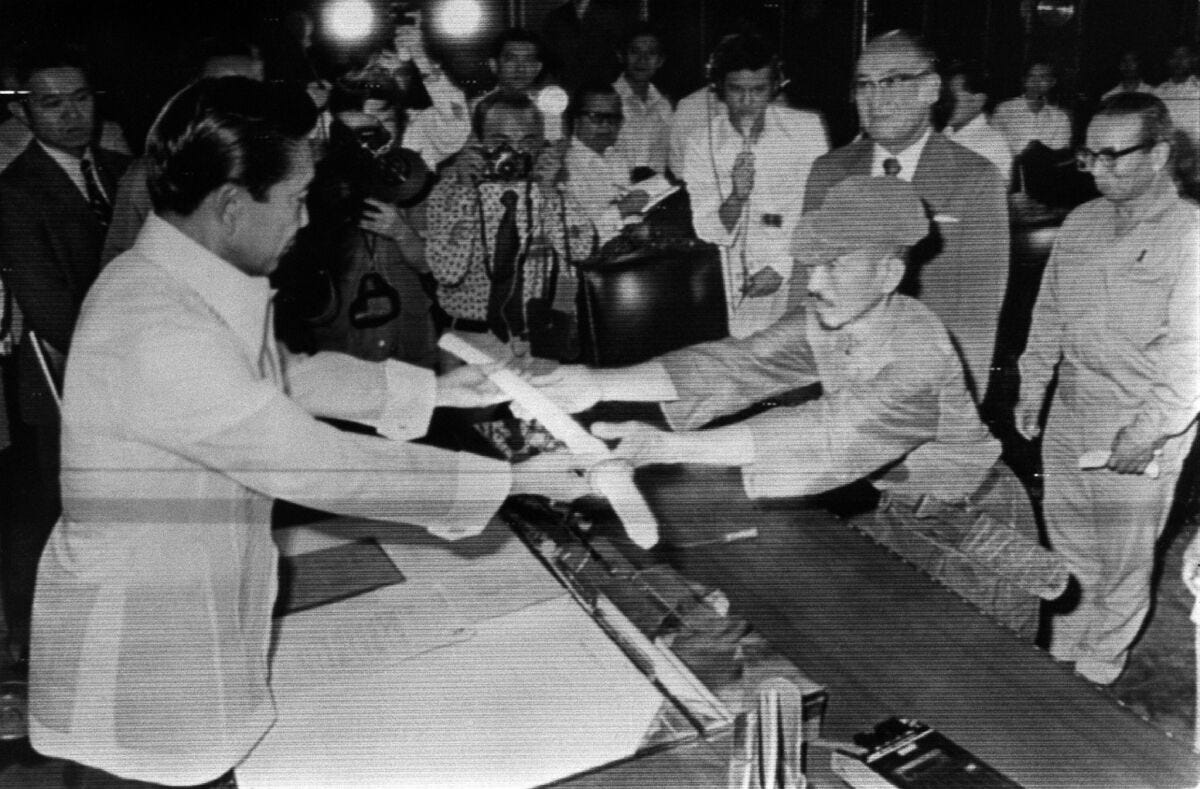
Back in Japan, Onoda was feted but felt out of place; soon enough, he decamped for South America, where he worked as a rancher. Eventually, he returned to his home country. (Shocked at reading in the newspaper about a young Japanese who had murdered his parents, he felt it his duty to counteract the anomie thus revealed by founding—what else?—a youth wilderness camp.) And so it was that, in 1997, while Herzog was living in Japan to direct the opera Chusingura, the filmmaker sought him out, apparently unaccompanied by cameras.
It’s too bad Herzog hasn’t (yet) made Onoda’s story into a movie—ideally (if only Onoda hadn’t died in 2014) a documentary like 1997’s Little Dieter Needs to Fly, about a German American Vietnam War pilot and POW, or the following year’s Wings of Hope, about Juliane Koepcke, the sole survivor of a plane crash in the Amazon jungle. Then again, such films, in which the survivor revisits the scene of their ordeal, are for the most part testimonials rather than reenactments. Relying largely on images conjured by words, they might seem a short step from the wholly written medium of The Twilight World.
Funnily enough, though, a documentary is exactly what the novella ends up feeling like. By and large, it adopts the perspective of a nonparticipant onlooker, essentially that of a camera operator. What we learn is what the camera might see. Questions that might preoccupy another writer—above all, what disposed the thoroughly ordinary Onoda, in his prior life a minor colonial opportunist, to such extraordinary fanaticism—are thus dismissed as inconsequential. And yet, as a headnote declares: “What was important to the author was something other than accuracy, some essence he thought he glimpsed when he encountered the protagonist of this story.” Clearly, the reduction of vantage point serves aims other than literalism.
Hence the imbecility of faulting The Twilight World, as some have done, for failing to provide a sociological account of Onoda’s mania—what amounts to faulting it for being a work by Herzog. Magical thinking and ritual actions are constants in his work. The classic Herzog film presents an act of faith—one whose concrete failure renders the act more grand by making it autonomous: not dependent for its meaning on its effect. Onoda fits the type perfectly. His practical assignments—to destroy the pier at Tilik and the airstrip at Looc—both fail. But these failures merely set the stage for a drama of persistence and renunciation that blends self-abasement with megalomania.
Despite their occasional self-rebukes for falling short of their mandate to engage in a guerrilla war “without glory,” what Onoda and his band dream of is really a kind of formalism: “Again and again,” the narrator tells us, “the men come to this point in their conversations. What should War look like? How could it be simplified?” Unable to accomplish anything, they yearn to stylize war to its essence: “two men fighting with sticks.”
To the practical man, the literalist, the men’s ignorance of the bombings of Hiroshima and Nagasaki will give their ruminations a distinct irony: As in so much else, they are simply out of date. As Herzog makes clear, however, they did not lack opportunities for being better informed. Much like Timothy Treadwell—the protagonist of 2005’s mesmerizing found-footage documentary Grizzly Man, the hero in the Herzog canon whom he most resembles—Onoda and his men are never as far from civilization as you might think, and not just because they depend on raiding the local Filipino farmers for supplies. Throughout Onoda’s years on the island, there are many attempts (by dropped leaflet, by audio recording broadcast by plane) to contact him and convince him the war is over. Yet Onoda always finds a way to persuade himself these are frauds or, perhaps, coded messages warning him not to surrender.
Such interpretive ingenuity can yield moments of sublime bathos. In the book’s most perfect scene, Onoda and his men encounter that quintessential found object: a piece of chewed gum. Stuck under a railing on a metal bridge deep in the jungle, it prompts anxious discussion. How long does gum last in the jungle? Is that indent the mark of a wisdom tooth? Do Americans even have those? Are they really men? Other ironies here are a bit on the nose. (When Onoda interprets the flights of bombers and passage of naval ships he witnesses over the years not as aspects of the Korean and Vietnam Wars, of which he is ignorant, but as movements in one long, unending war—what Herzog evidently intends us to view as the war that is modernity as such—such would-be wisdom of the holy fool feels trite.) The gum, though, stubbornly is what it is.
The existential comedy of this encounter with brute, stupid reality, is a reminder of everything The Twilight World shares with Herzog’s greatest films; it also measures how far this slight prose work falls short of them.
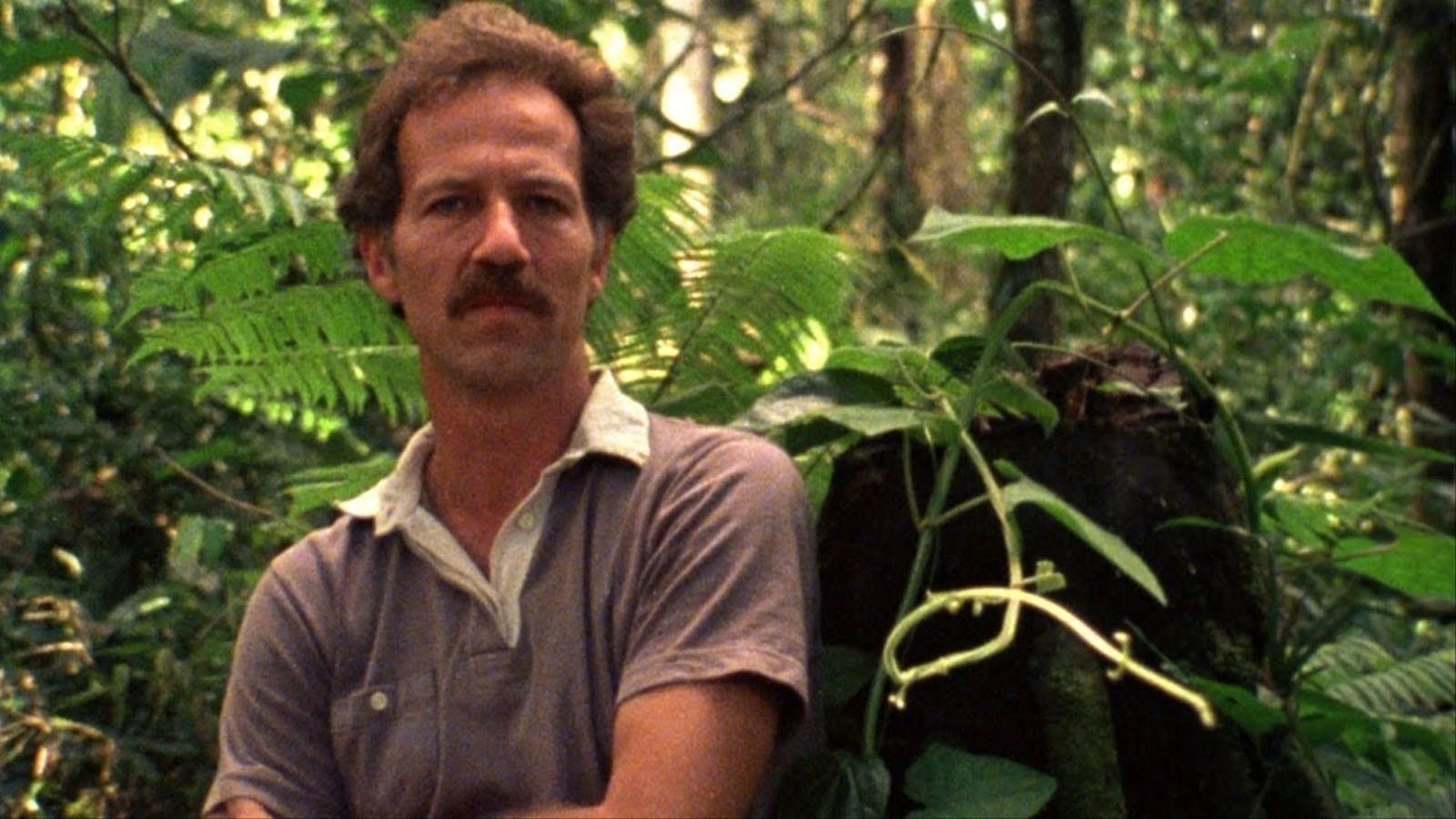
“We do not need virtuosos of syntax,” Herzog wrote to himself while filming Fitzcarraldo, presumably referring to film grammar (though Herzog’s appreciation of syntax in the literal, linguistic sense is doubtless as fine as that of any filmmaker you could name). He thereby declared his commitment to the reality in front of his lens—albeit not as an end in itself, but as the embodied sign of some larger vision that defies representation.
There has always been something refreshingly primitive in Herzog’s film technique, with its high reliance on hand-held cameras and willingness to shoot on location using natural light. (In the early masterpiece Aguirre, the Wrath of God, you never quite lose the sense of seeing what in fact you are: cheaply costumed actors hacking their way through the jungle accompanied by a documentary film crew.) In such films, the reality of whose making erodes that of the story, the suspension of disbelief gives way to the test of faith. Reading The Twilight World, you can’t help missing the filmed works’ requirement that the symbolic act be real.
It isn’t as if writing is incapable of kindred performances. Herzog’s 1974 book Of Walking in Ice originated as a journal he kept while he walked from Munich to Paris in early winter to be by the bedside of the German film historian Lotte Eisner, believing that doing so would prevent her from dying. (He arrived; she did not die.) Conquest of the Useless (2009) reproduces a notebook he kept during the filming of Fitzcarraldo, which he claims he could not bear reading for several decades. There is something exiguous about both books; each is in some sense a byproduct. This is the source of their life. At its best, Herzog’s writing in The Twilight World approaches a fable-like simplicity, with a gentleness that is almost painful. What is missing is any sense of risk. Nothing here feels wrung from him.
Whatever motivated the translator, the ever-resourceful Michael Hofmann, to render the title as The Twilight World, the phrase misses an important resonance of the more accurate rendering “twilight of the world,” as it appears in the text. Few modern artists seem less dispirited than Herzog at the prospect of the world’s destruction. An exit from civilization is certainly to be welcomed. Crucially, this does not mean an escape into a pristine nature that no longer exists, that was never hospitable to humans, and that he refuses to countenance even in imagination (early in the novel, we read of the jungle “crackling and flickering like loosely connected neon tubes”).
Instead, Herzog is drawn to something simpler: relative independence, reliance on modest technical means, an escape from bureaucratic routine and predictability. (Though he does not omit the irony that Onoda generates his own highly organized routine in his long years on the island and is devastated when he learns that his calendar had been off by several days.)
Among the indignities of the world is that it reduces grand efforts to foolishness—the usual Herzog theme. The Twilight World aims to do the reverse: “After that, Onoda and Shimada [another of the holdouts, who will later be killed by a search party looking for them] are on their way, off into the decades that lie ahead of them. Often walking backward so that their traces are heading in the wrong direction.” It’s an irresistible image, wistfulness and absurdity there for the taking. One worthy of a much better novel—or movie.
This piece previously appeared—in verbose and altogether inferior form—in The Nation under the title “Werner Herzog’s Exit from Civilization.”
Good post. I read Onada's memoir when it came out. I found him admirable. Onada's perseverance reminds of a line from Tennyson (inaccurately) about the Duke of Wellington: "Seeking only duty's iron crown." The Herzog novella sounds good.
Paul, very nicely done. From childhood, I hazily remember not the ceremony of surrender, but the fact of the long fight, and its coming to an end. I also like Herzog, and thought Aguire the Wrath of God one of the all time great titles. And this essay is full of really fine observations of what Herzog is doing, especially the sort of mystical essentialism that seems to be the core of the artist. If I might offer a small criticism: after you say so many insightful things, I'm a little unclear on why the book is "slight." Doesn't take enough risk doesn't seem like enough . . . anyway, really good criticism, makes me want to watch some Herzog and reread. Thank you.