
Conjectures
Radically extended life is still finite life, comically so. (Cosmically so.)
Or should I say bathetically? Martin Hägglund, in This Life, speaks of my finitude as giving my life meaning, by putting something at stake for me, in all my actions. The radical life extender also has something at stake: the further perpetuation of his life. But, if so, the stakes themselves undergo a caricatural transfiguration; instead of seeking to be judged by the eye of eternity, or in the kleos perpetuated by future generations—that is, instead of aspiring to those conditions that Hannah Arendt called “Work” and “Action”—such extended life is, instead, reduced to what Arendt calls “Labor”: mere biorhythms, perpetuated, meaninglessly, into infinity, or rather indefinitely. The Masters who achieve this condition have, in the truest sense, become Slaves.
Would radical life extension not run into Lockean problems of personal identity? Can memory be hyperextended to a commensurate degree to guarantee the perpetuation of the person?
How extend one’s personality—one’s capacity of self-retrieval—through a wished-for infinity of time?
Could one, through a series of forgettings, become a series of successive selves? Could one, after millennia of a later self, undergo the retrieval of an earlier? Could one achieve thus a fusion of past and future selves? In a kind of autoerotic hierogamy? Is that to be wished for? Is that what our great hopers and planners today, wish for?
Strange, that it should have come to me only recently, my last time at the grocery store. As if catching myself unawares, in a thought I was not conscious of having—but which I seem—until now—tacitly to have had? The notion of stocking up, of laying in supplies: as if, this time, I will have made the right grocery purchases, once and for all. (For the same reason that I never really keep a budget of my groceries purchases, but merely buy what I need and eyeball the cost; going generally for the cheaper option but, with time, growing more lackadaisical, or rather more extravagant.) But did I not now catch myself in the counter-realization: that I will have to keep doing this, over and over—unto the death! (Should I then make a budget…? I think I will not.)
In a Lonely Place, besides having one of the two most beautiful movie titles (it’s something about the letter L; the other is Light Sleeper—not nearly as good a movie), is also the most beautiful cinematic depiction of love: of trust, of playacting, the co-construction of a fantasy, a fiction, walking up to the boundary of that most delirious thing, but not falling into it: the fall into reality, which is also a kind of consummation; the boundary of the lovers killing each other... (Does not Light Sleeper—not as film, but as title—evoke the same fragile boundary? Journeying together in sleep, so fragile the membrane between that condition and waking; and is not our life a sleep…?)
A strange thought comes upon one… not knowing where or when or how I shall meet my death… is it not, being killed, being cited, one and the same? What god knew, at the spinning of the thread upon his conception, that the spear was to lay low Priam’s son on that particular three-ell plot of ground? What demon knew that my soul was to emerge into presence, to throb this particular throb, on page 176, footnote 3?
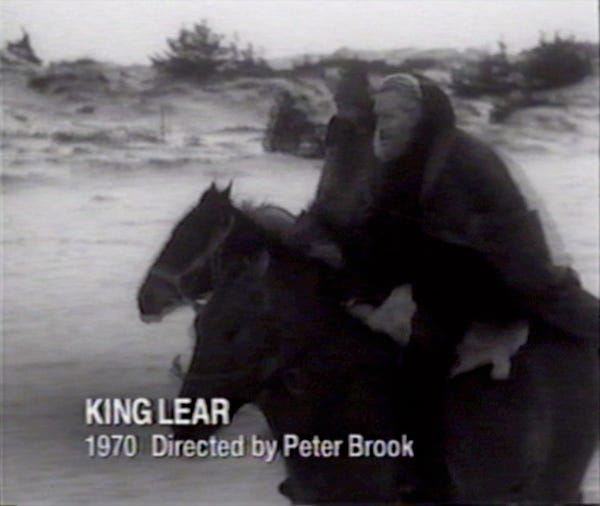
Wherein lies Lear’s tragedy? It’s sad to see an old man die—ok. A penny for the old guy. Is that all? Everything is taken from him. He is made childish, reveals himself as such. He wants his cake and to eat it—he wants to see his will disbursed while he is alive and enjoy his old dignity, without abridgement, except in responsibility. We are ashamed for him. We are ashamed of him. To look on him is to look like Noah’s sons on their father’s nakedness. (Yet is Poor Tom’s own nakedness not the cloak that covers the father?) In this play indeed is a deluge. It is the generational change; it is the Flood. It is the death of fathers that all might secretly wish but that all also fear, because in the fathers they see their origins, themselves. And yet, he is grand. Grand in what? That he rages against the heavens? No heath, no tragedy. No reduction, no grandeur. The stage magnifies him. (And this is why Kozintsev, though so great in Hamlet, is so poor a director of Lear—which he oddly Christianizes with mise-en-scene of crucifixes and stage dressings, but which he most travesties with an overhead, crane shot of Lear upon the heath—thereby minimized; his paltriness made manifest; when what we ought to see, in that solitary man upon the stage, is a funnel gathering the energies of the audience and them upward, as in a funnel of flame—“reversed thunder,” as Herbert said of prayer.
No heath, no abjection, no grandeur. The enactments on the heath are recapitulated in Cordelia’s death (“undo this button”)—the nudity of death echoing the nudity of vulnerability; the Fool collapsed into Cordelia; yet Edgar present, witnessing, though it is Kent, his hands, who unfastens.
“…all this buttoning and unbuttoning…”
A persistent feature in the science fiction novels of Kim Stanley Robinson—the Mars trilogy, for example—is that human life has become more extended due to certain limited improvements in managing metabolic health, but the characters we see living so much longer also suffer a creeping indistinction of memory. Their farther past loses some texture, urgency, and clarity. It’s replaced by details of the more recent past, like a second youthfulness. It’s not even a main point of Robinson’s novels, which tend to be about revolution and large-scale eco-social projects. But he imagines people stretched hazily over time, as if the window of memory stays the same size no matter the years.