
Afterthoughts
On Romanticism, Modernism, Vitalism
Further reflections on the topic of my recent Republic of Letters essay on “Why We Need a New Romanticism”
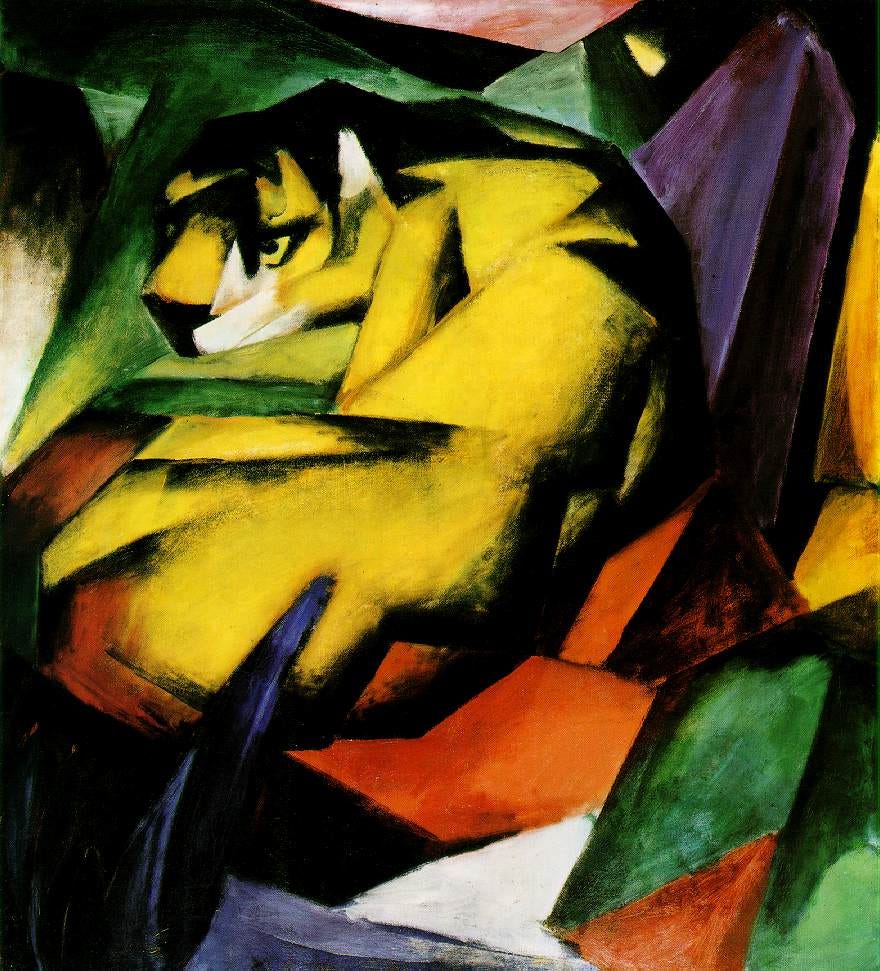
The provocation of Hulme: to distinguish between the Absolute and Nature. Contrast this with the Blakean-Romantic distinction between Energy and nature. Energy in this conception not so much good as beyond good and evil; yet, insofar as it is beyond good and evil, it is “good” rather than “bad,” inasmuch as life, strength, are allied with the Romantic principle rather than that of Death.
(In “The Tyger” one sees anticipated that shift Charles Taylor proposes as having helped give rise to the Modernist as distinguished from the Romantic: in Taylor’s view, in Sources of the Self, that there had been, besides the industrial explosion, “a shift in the sense of nature as a force, which came to be less and less captured by Romantic notions of spiritual reality, and more and more matched by a vision like Schopenhauer’s: nature as a great reservoir of amoral power.”)
One turns to the Romantic in a time of devitalization. Ours is a time of flourishing of boutique modes of transcendence, but not the kind that counts; call it the “negative transcendence” within the body, that accepts its limits. We need a transcendence on the soul’s own steam. (This, I hope—given its allusion to this Romantic-era technology—will be taken as metaphorically apt, even if the great Romantics themselves, J. M. W. Turner perhaps among them, showed ambivalence about this technology.)
Mailer’s, it will be objected, is not a Romantic spirit—is mere primitivist barbarism. Yet note his championing of the “eighteenth century” (“I agree with you, it was a very fine century”), albeit less for what it devised than what it preserved, in spite of itself. But the chief question concerns the propriety and legitimacy of an individual vision—that which selects, that says whether what it sees is good or bad; or, as Mailer puts it, appropriately, whether what it looks upon is a beautiful or an ugly body.
Charles Taylor (again) in Cosmic Connections, places the T. S. Eliot of The Waste Land in a heritage of Romanticism on account of its gesturing toward a plenitude of being, of life and fertility, even if it does not produce it for view. (This includes not producing “statements” about it; hence Taylor’s shrewd classification of his poem as “post-symbolist.”) Fredric Jameson, on the verge of formulating his doctrine of postmodernism, champions the mechanistic theories of Wyndham Lewis on the postmodern grounds that his writing style is a “machine for producing sentences”—apparently oblivious of the fact that the Lewis sentence-machine is itself metaphorical, and that Jameson’s championing of Lewis’s style in terms of its “energies” starts to look like a reversion to the very (if I may quote the devil against himself) vitalism the sentence-machine repudiates.
Why a New Romanticism? Why not? Academic reasons—historical and demographic specificity and thus constructedness of the Romantic self—we may leave by the wayside; let the persuaded bury the persuaded.
These are, in any case, the criticisms the post-moderns made of the moderns, whom they indict for self-importance. But does this not amount to a confession of one’s own unimportance? To say we need a new romanticism amounts to saying life is to be lived. And what then of irony? In the deepest sense, we have not yet begun to be ironic.
